
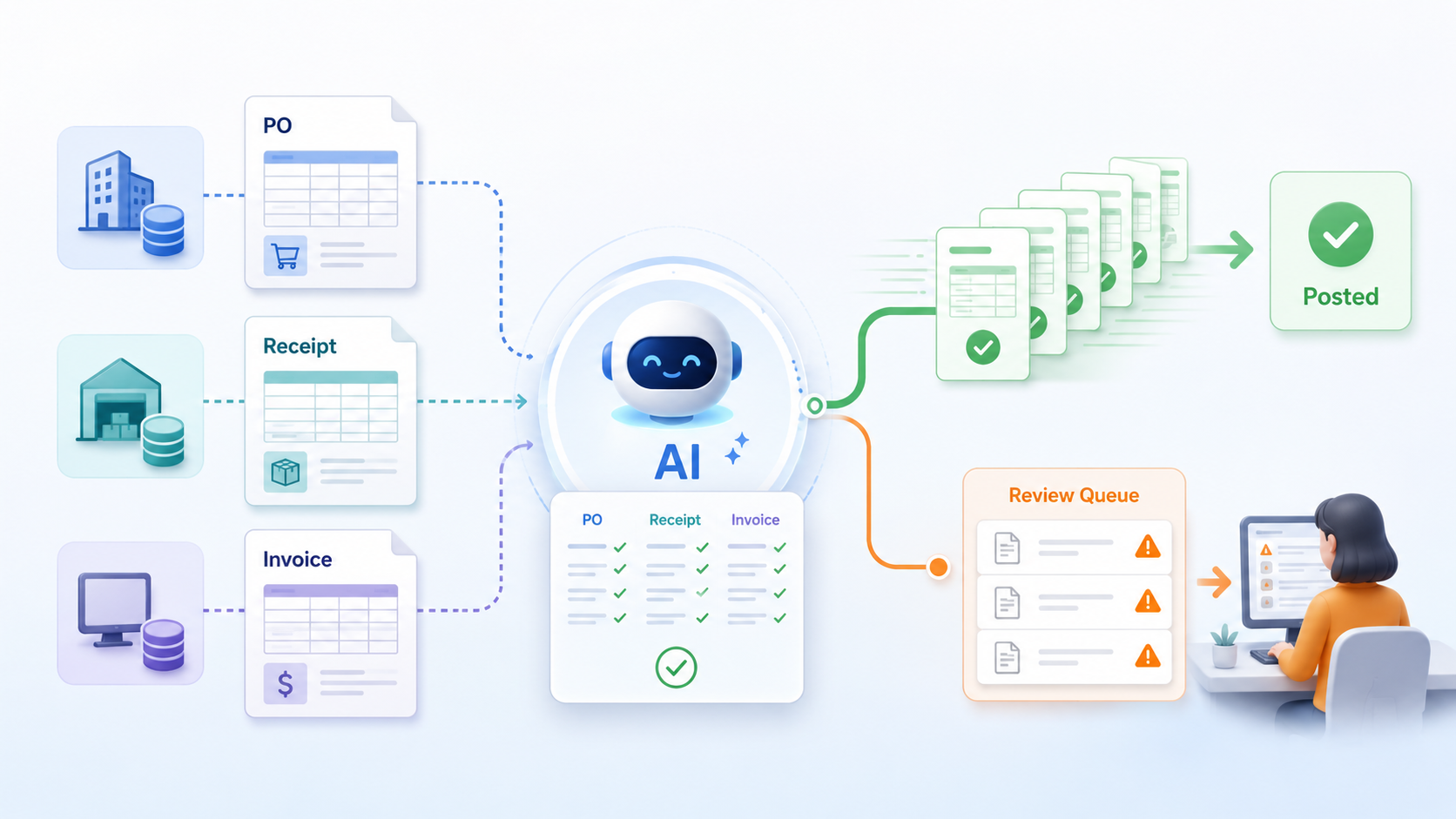
A single invoice can mean opening three systems: the purchase order in procurement, the receipt in the warehouse tool, and the invoice itself in a shared inbox. Multiply that by every vendor, every month, and accounts payable spends more time reconciling than paying.
Reconciliation eats the days before close
Three-way matching — checking a purchase order, a receipt, and an invoice agree — is simple in principle and slow in practice. The three documents rarely live in the same system, and a mismatch means someone has to track down which figure is right before the invoice can be posted.
The volume makes it worse. Most invoices match cleanly, but the team still has to open every one to find out — so the small share that genuinely need attention are buried in the rest.
AP teams
Spend close week chasing mismatches instead of closing the books.
Vendors
Wait longer for payment while a routine invoice sits in review.
Finance leaders
Get less visibility into what's actually outstanding, and why.
What if the invoices that matched cleanly posted themselves, and the team only ever saw the ones that didn’t?
Every invoice takes the same path, match or not
In most AP workflows, an invoice moves through the same review sequence whether it matches perfectly or not — the exceptions and the routine cases are indistinguishable until someone has already looked.
- Invoice arrives
- Pull PO
- Pull receipt
- Compare line items
- Chase mismatch
- Approve
- Post
It works, but it treats every invoice as a potential exception. The clean matches — the majority — still consume a reviewer’s time, and the genuine exceptions don’t get found any faster for it.
An AI-powered matching agent
Instead of a person opening every invoice, the agent pulls the purchase order and receipt the moment an invoice arrives, compares them line by line, and posts what matches automatically. What doesn’t match — a quantity difference, a price variance, a missing receipt — is the only thing that reaches a reviewer, with the discrepancy already identified.
Four steps, before an invoice reaches a reviewer
- 1
Capture
The agent reads the invoice as it arrives — PDF, email attachment, or a vendor portal feed — and extracts the line items.
- 2
Retrieve
It pulls the matching purchase order and goods receipt from procurement and warehouse systems.
- 3
Match
It compares quantities, prices, and terms across all three documents, line by line.
- 4
Resolve
Clean matches post automatically. Anything that doesn't match goes to a reviewer with the exact discrepancy flagged.
What the reviewer receives
- The specific line-item mismatch
- PO, receipt, and invoice side by side
- Vendor and payment terms
- A suggested resolution
- Match confidence and history with this vendor
A routine restock order
A vendor invoice comes in for a standard restock — same quantities and prices as the purchase order and the receipt on file. In the current process, it still waits in the review queue behind everything else. With the matching agent, it’s compared and posted within minutes, and the AP team never has to open it.
| Today | With AI matching | |
|---|---|---|
| Where matching happens | Manually, across three systems | Automatically, the moment the invoice arrives |
| Clean matches | Reviewed like everything else | Posted without a human touch |
| The AP team's time | Spread across every invoice | Focused only on genuine exceptions |
The result is not AI approving payments unsupervised. The result is AI clearing the routine matches — so the team’s attention goes to the discrepancies that actually need a decision.
A faster, cleaner close
For AP teams
Less time reconciling, more time on genuine exceptions.
For vendors
Faster, more predictable payment on invoices that match cleanly.
For finance leaders
A closer, more accurate real-time view of what's outstanding.
Powered by Chocolate Factory
An invoice-matching agent works across procurement, warehouse, and finance systems, applies consistent matching rules at volume, and knows exactly when to stop and hand off to a person. It is built on Chocolate Factory, Xtremax’s agentic AI platform.
Platform capabilities behind the agent
- Configurable prompts and models
- Agent observability
- AI workflow orchestration
- Multi-agent platform design
- Integration with ERP and procurement systems
- Governance, security, and scalability
One agent today, a finance operations pipeline tomorrow
Invoice matching is one part of what agentic AI can do in finance operations — the same platform approach extends across the close, and gains value as each piece is built on shared infrastructure rather than as a disconnected tool.
Payment scheduling
Optimise payment timing against terms and cash position.
Vendor enquiries
Answer routine status questions without a ticket.
Duplicate detection
Catch duplicate or erroneous invoices before they're paid.
Expense coding
Suggest GL codes based on vendor and line-item history.
Spend anomaly detection
Flag unusual spend patterns for a controller to review.
Close-cycle reporting
Executive visibility into close progress and outstanding items.
Finance teams don’t need more spreadsheets. They need the reconciling work handled consistently, so the close is about reviewing judgment calls, not chasing figures across systems. AI does not replace the AP team. AI clears the routine matches — and a lighter queue means a faster, more accurate close.
The short version
- Three-way matching is rules work, and rules work is what an agent does best.
- The agent clears the clean matches and escalates only the exceptions.
- Every match keeps a trace, so audit is a query rather than a reconstruction.
- Finance keeps the judgement calls, and gets the evenings back.